


Highlights from Africa Climate Week: Multilevel governance, a key enabler of a new dispensation for climate ambition and action
Published: 19 Sep 2023
Climate Finance
Events
Success Stories
Bangui
Dire Dawa
Embu County
Garoua 3
Kampala
Kloto 1 / Kpalimé
Lusaka
Municipality of Walvis Bay
Nakuru County
Nouakchott
Quelimane

African subnational governments have evidence-based plans and projects to accelerate climate action, but significantly increased funding is needed to implement these at scale.
An unprecedented number of subnational government leaders present at the Africa Climate Week and Summit, held from the 4th to the 8th of September in Nairobi, Kenya called for the mandatory inclusion of subnational governments in the preparation of the next phase of Nationally Determined Contributions (NDCs) to be submitted to the United Nations Framework Convention on Climate Change (UNFCCC) by 2025, re-emphasising the critical importance of multilevel governance in tackling the climate crisis.
The Covenant of Mayors in Sub-Saharan Africa (CoM SSA), the Local Governments and Municipal Authorities (LGMA) Constituency, Cities Race to Resilience, the COP28 Presidency and other partners co-convened the high-level opening for Africa Climate Week Track 2: Cities, Urban and Rural Settlements, Infrastructure, and Transport. In this session, the resounding message was that African subnational governments have the plans and projects that can enable a new dispensation of climate ambition and action. CoM SSA alone has 310 projects extracted from comprehensive climate action plans, worth an estimated 3 billion EUR, needing further support.

“Over the past few years, the financial support we have provided to prepare feasibility studies at the local level, through CoM SSA and our city investment facility, has leveraged a commitment of 1.4 billion Euro for transformative investments in over 50 cities on the continent.”
The importance of multilevel action in achieving the climate action agenda was made clear by the COP28 Presidency’s Senior Advisor for Programmes and Partnerships, Ms Shahbano Tirmizi who announced that “multilevel action will cut across all thematic days at COP28, and we will also have a specific day for multilevel action, urbanisation and cities on 6 December, and on this day we will also host the 2nd Ministerial Meeting on Urbanisation and Climate Change.”
Cities are first responders in the fight against climate change. There are climate solutions being implemented on the ground in African cities and now is the time to scale them, through collaboration and partnerships.
Director at the Directorate Afrika II, Federal Ministry of Economic Cooperation and Development (Germany), Mr Philipp Knill said “When it comes to implementation, cities are central. We work through city networks like the Global Covenant of Mayors for Climate and Energy and ICLEI, promoting partnerships between German and African cities. We can learn a lot from each other.”
CoM SSA Regional Mayors Forum Africa Climate Week Declaration
The CoM SSA Regional Mayors Forum, whose members were elected by their peers and represent the voices of over 350 CoM SSA signatory cities, is currently composed of 11 mayors representing the four regions of sub-Saharan Africa (Southern Africa, Central Africa, Western Africa, and Eastern Africa). On the sidelines of Africa Climate Week, the Regional Mayors Forum met with Ms Carla Montesi, Director at the European Commission’s Directorate General for International Partnerships, who announced that the European Commission has succeded to mobilise an additional EUR 20 million for the next phase of the CoM SSA initiative which is making a significant impact at the local level.
At this meeting the RMF members, representing a total population exceeding 150 million people, also developed the CoM SSA RMF Africa Climate Week Declaration, which calls for:
- increased funding to be made available to prepare local projects that have already been developed and endorsed by African cities, regions and towns.
- a COP28 decision that mandates the inclusion of subnational governments in the revision of Nationally Determined Contributions in 2024 and 2025.
- the honouring of national and international commitments to the just energy transition in Africa, and the transfer of the technology, knowledge and financial resources necessary for Africa to harness its renewable energy potential, while simultaneously tackling developmental backlogs and clean cooking and energy access shortfalls.
The RMF Chairperson and Global Covenant of Mayors for Climate and Energy (GCoM) Board Member, Mayor of Kloto 1 (Togo), Yawo Winny Dogbatse delivered the Declaration at the Africa Climate Week Track 2 high-level opening. Read the full Declaration here.
The RMF members are committed to urgently accelerating urban climate action in sub-Saharan Africa, recognising that the future of the African continent depends on radical collaboration, especially between the Global South and Global North.

representing the President of the Nouakchott Region, Ms Fatimetou Abdel Malick; Special Advisor to the Mayor of Dire Dawa (Ethiopia): Mr Yusuf Tajudin Abdulahi,
representing Mayor Mr Kedir Juhar; Deputy Governor of Nakuru (Kenya): Mr David Kones, representing the Governor, Ms Susan Kihika; The Mayor of Quelimane (Mozambique):
Dr Manuel de Araújo; The Mayor of Walvis Bay (Namibia): Mr Trevino Forbes; Head of CoM SSA Secretariat: Dr Meggan Spires (Front row): Mayor of Bangui (Central African Republic):
Mr Emile-Gros-Raymond Nakombo; The Vice Chairperson of the RMF and Mayor of Lusaka (Zambia): Ms Chilando Chitangala; Director at the
European Commission’s Directorate General for Development and Cooperation Ms Carla Montesi;
Lord Mayor of Kampala (Uganda): Mr Erias Lukwago; The Mayor of Garoua III (Cameroon): Dr Abdourrahmane Maïkanti
Tangible examples of multilevel climate action
CoM SSA hosted an Africa Climate Week side event: Multilevel Climate Action in Africa: Tangible examples, ready for scaling, where CoM SSA signatories shared their climate ambitions, plans and experiences. A snapshot of some of the highlights of this session are shown below:
CoM SSA Regional Mayors Forum member, Mayor of Quelimane (Mozambique) said: “We experienced 3 cyclones this year, causing widespread devastation. This emphasises the urgent need for improved disaster preparedness and proactive resilience building. If it wasn’t for mangroves I’m sure my city of Quelimane would not be there. We train our communities and fishermen to protect and restore our mangroves.”
Through the support of @CoMOSSAfrica, we've developed effective #wastemanagement programmes, which the local community feels ownership of.
— Covenant of Mayors in Sub-Saharan Africa (@CoMOSSAfrica) September 8, 2023
Everything we've been able to do has been through collaboration!
~ Mr Nicholas Ngece
Chief Officer of Environment, Embu County (Kenya) pic.twitter.com/wgwHMG90k9
The newest member of the CoM SSA Regional Mayors Forum, Mayor of Walvis Bay (Namibia) highlighted that being a small municipality does not mean that you have small climate ambitions: “Some have over 2.5 million people in their capital city. In Namibia, we have 2.5 million people in the whole country. But we’re taking bold climate change action. For example, we are in the early stages of developing a waste-to-energy project.”
.@NakuruCountyGov practices climate-inclusive decision-making w marginalised communities & indigenous groups who will be most affected. We aim to educate every person on fighting #climatechange.
— Covenant of Mayors in Sub-Saharan Africa (@CoMOSSAfrica) September 8, 2023
Decision-making must include marginalised communities.
Hon Dep Governor David Kones pic.twitter.com/SWC5uoaO1I
Calling for support in urgently accelerating urban climate action on the continent
Throughout various other engagements and events at Africa Climate Week CoM SSA Mayors and Governors called on the international community to work with African cities in:
- increasing climate finance accessed directly at the local level,
- supporting contextually appropriate efforts to scale access to sustainable energy,
- increasing investment in nature-based solutions at the local level,
- prioritising the water and sanitation sector in all development efforts on the continent,
- including the voices of women, indigenous people and youth in decision-making, and
- strengthening multilevel governance, working together at all levels from the local to the international, to make a tangible difference.
As we move forward to COP28, it is critical that this momentum is not lost and that the urgency ramps up, only then can we ensure that enough finance flows to where it is needed most - the local level.
View CoM SSA’s latest video, Climate action needs climate finance, launched at Africa Climate Week
.
CoM SSA is co-funded by the European Union (EU), German Federal Ministry of Economic Development and Cooperation (BMZ), and the Spanish Agency for International Development Cooperation (AECID).
ICLEI Africa hosts the CoM SSA Secretariat.
 Share On Facebook
  Share On X
  Send Via Email
 Related Articles
-

Implementing a climate action plan: lessons and inspiring examples from African cities
All CoM SSA signatories commit to developing a Sustainable Energy Access and Climate Action Plan (SEACAP). But a climate action plan only delivers impact when its priorities are reflected in budgets, institutions, projects and investments. A SEACAP is therefore not the end of the journey: it provides the evidence base and strategic direction for implementation.
View articles -
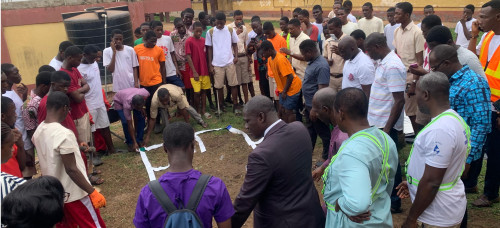
Bringing biogas to Ghanaian schools
In partnership with Oekobit, the Covenant of Mayors in Sub-Saharan Africa co-implementing partner GIZ, and the Sekondi-Takoradi Metropolitan Assembly (STMA), Ghana, is implementing school-based waste separation and biogas systems that reduce waste while generating renewable energy.
View articles -

Renewable energy as a vehicle for equity and urban resilience in sub-Saharan Africa
As cities across sub-Saharan Africa continue to grow, so too does the urgency to ensure that urban development is powered by energy systems that are reliable, affordable and equitable. This was the central message emerging from the recent Regional Dialogue on Renewable Energy, co-hosted by the Covenant of Mayors in Sub-Saharan Africa (CoM SSA) Secretariat, Global Covenant of Mayors for Climate & Energy (GCoM) and REN21.
View articles