


Douala’s energy transition opens doors for investment
Published: 25 Feb 2025
Climate Finance
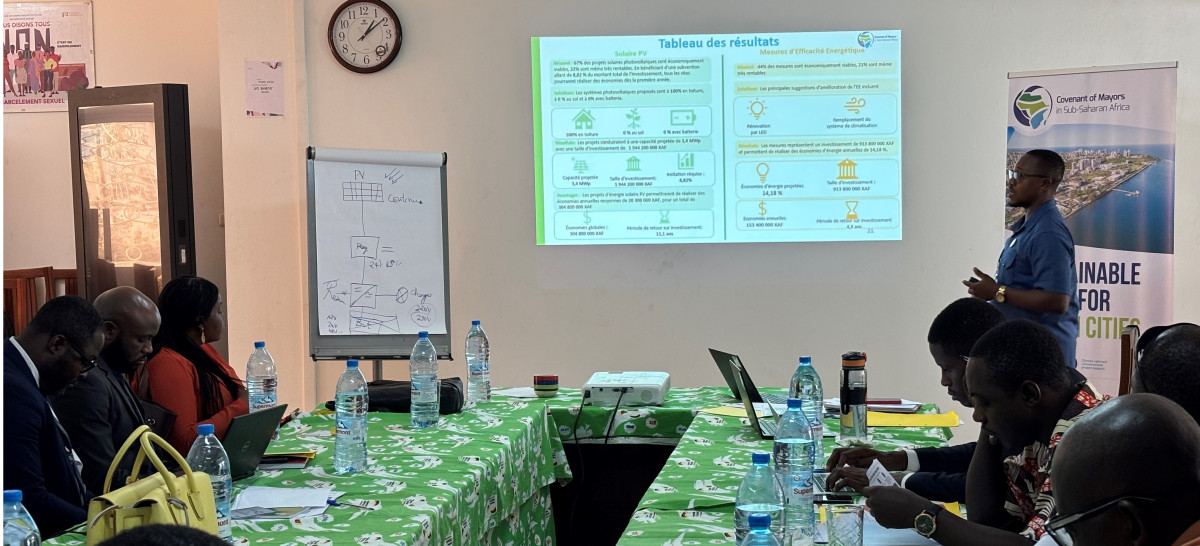
With rising energy demand and only 75% of Cameroon's urban population having access to electricity (World Bank, 2025), Douala is accelerating efforts to expand clean energy solutions. Over the past seven months, CoM SSA through its Urban Smart Energy (USE) product, in collaboration with municipal leaders, energy experts, legal advisors, and financial specialists, has assessed the feasibility of renewable energy and energy efficiency projects across nine municipal sites. Their findings lay the groundwork for a cost-effective urban energy system and a strong case for future investment.
During a two-day workshop, participants explored various aspects of USE, which focuses on deploying decentralised energy systems and efficiency measures in municipal sites, ultimately reducing energy costs and boosting local economic opportunities.
In 2023, nine municipal sites were preselected for assessment and smart meters were deployed to track energy consumption. The insights delivered by the smart energy meters provide data-driven decision-making tools that help cities implement effective energy-saving strategies. They also inform the development of tailored photovoltaic system designs and energy efficiency measures. Experts evaluated nine sites, considering investment requirements, PV system sizing, emission reduction potential, and financial projections. To ensure financial viability and attract investors, experts focused on key factors such as:
- a projected internal rate of return (IRR),
- a power purchase agreement to guarantee long-term stability, and
- inflation forecasts for electricity pricing to anticipate future costs.
Beyond discussing technical feasibility, participants also addressed the legal and financial frameworks required to scale these projects. The participants explored ownership models, service agreements, and procurement processes to align with national regulations. While some aspects of the financial model sparked debate, alternative funding options, including public-private partnerships and concession agreements, were considered to accelerate implementation.
The next steps include selecting priority sites for tendering and securing financing. The availability of smart meter data provides Douala’s municipality with a stronger investment case, ensuring that energy efficiency measures and renewable energy projects are based on real consumption patterns and projected cost savings.
Turning these insights into tangible projects will require strong collaboration. Private sector actors and financiers have a strategic opportunity to engage, bringing expertise, funding, and innovative solutions to drive Douala’s transition to a more efficient urban energy system. With the right investments and partnerships, Douala can set a precedent for the region, demonstrating how smart energy planning leads to economic and environmental gains.
 Share On Facebook
  Share On X
  Send Via Email
 Related Articles
-

Advancing access to finance for urban infrastructure in Africa
Positioning GIZ CoM SSA within Global Gateway at the EU Regional Business Forum in Abidjan
The EU Regional Business Forum held from 30 March to 1 April 2026 in Abidjan, Côte d’Ivoire, brought together finance institutions, European investors, and public sector stakeholders, strengthening connections between the EU Global Gateway investment agenda and African government priorities, with African governments as partners and co-creators. GIZ, under the CIVIC Platform - Climate Resilient Infrastructure Investment in Cities, is one of the implementation partners of the Covenant of Mayors in Sub-Saharan Africa (CoM SSA), and joined the forum to showcase how locally grounded urban priorities can connect to the EU’s policy and investment mobilisation agenda.
View articles -

Bridging the gap: African cities prepare for the IPCC Special Report on Climate Change and Cities (SRCC)
Global efforts to strengthen urban climate resilience advanced at the From Science to Action workshop in Bonn, convened by Deutsche Gesellschaft für Internationale Zusammenarbeit (GIZ), UN-Habitat, and the Global Covenant of Mayors (GCoM). The session focused on one central question: how can the forthcoming Intergovernmental Panel on Climate Change (IPCC) Special Report lead to practitioner-oriented action in cities?
View articles -

Unlocking private investment for urban solar in Africa: Key players convene to address financing gaps
Over 600 million people in Sub-Saharan Africa still lack access to electricity, with urban populations expected to double by 2050. On-grid rooftop solar presents a strong opportunity to power public buildings, lower energy costs, and strengthen climate resilience. However, investment remains limited due to persistent financing gaps and market barriers.
View articles