This
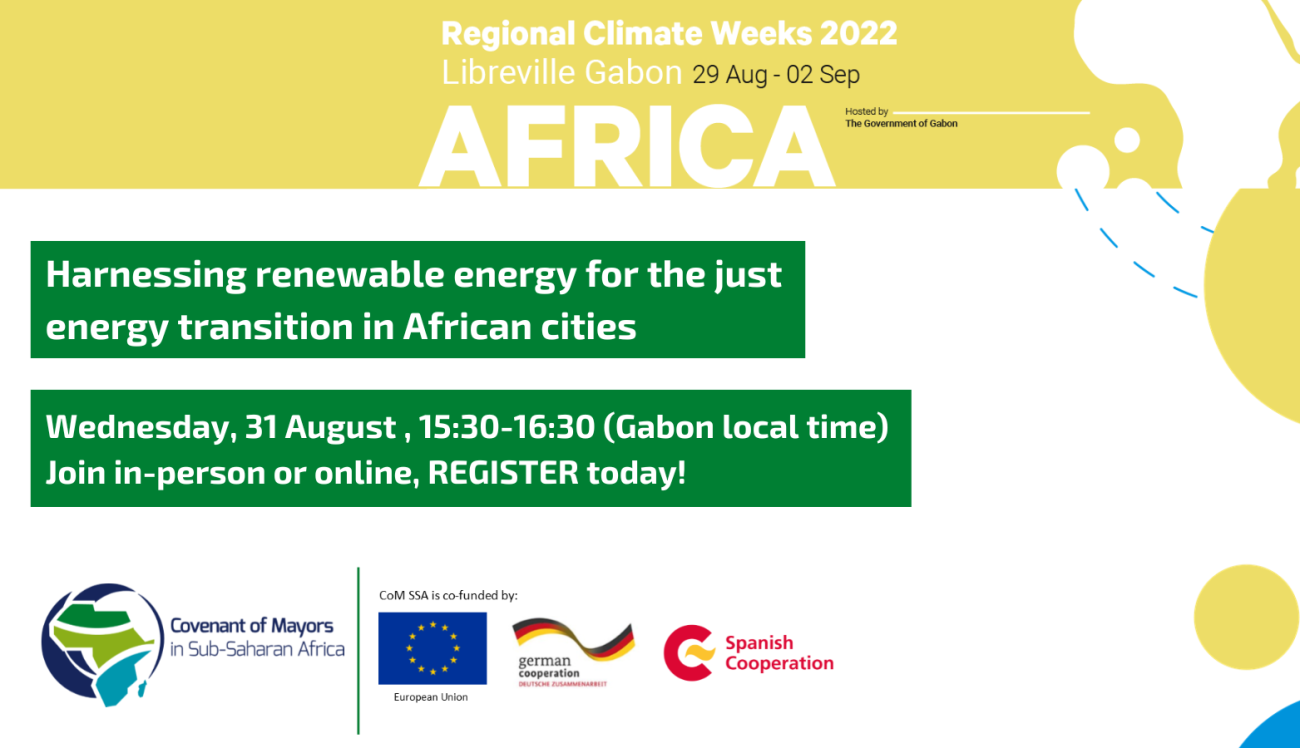
Africa Climate Week side event, hosted by the Covenant of Mayors in Sub-Saharan Africa, provides an excellent opportunity for representatives across the continent to advocate for harnessing renewable energy to accelerate the Just Energy Transition (JET) and share experiences with regard to attracting finance for the JET in Africa. This is particularly important in the run-up to COP 27, advocating for concrete climate change action whilst leveraging innovation and putting justice at the forefront of it.
Africa Climate Week 2022 will be held from 29 August to 2 September in Gabon. This side event, convened by the CoM SSA Secretariat which is hosted by ICLEI Africa, aims to fulfil the theme under track 3 of Africa Climate Week: “Enabling the future - Seizing transformation opportunities, exploring technology innovation and investing in breakthrough solutions”. It aims to bring together renewable energy experts, government officials, Development Finance Institutions (DFIs) and private sector partners to discuss the JET in the Sub-Saharan Africa context.
Africa contributes less than 10% of total global greenhouse gas emissions, however, it is the continent most vulnerable to the impacts of climate change. 35% of total emissions are derived from the energy sector in Africa. Therefore, the deployment of renewable energy (RE) technologies, which have immense potential in many African cities, can significantly reduce these emissions and avoid future emissions as Africa strives to meet its sustainability goals. Considering that the majority of cities in Africa still have significant levels of development to achieve, including overcoming inequalities such as 568 million people without access to electricity and 923 million people without access to clean cooking; there is an urgent need for Africa to charter a low carbon and resilient development trajectory, whilst achieving deep transformative change.
The JET is championed as a turnkey solution to not only facilitate bold, ambitious climate change action at scale but also aims to ensure that socio-economic challenges are taken into consideration and improved through the concept of ‘justice’ and putting people first. This is particularly imperative from a Global South perspective in order to advance the sustainable development agenda. When it comes to understanding the foundation of any JET, the three forms of justice namely:
1) procedural justice (empowering marginalised groups and including those affected in transitions in decision-making processes);
2) distributive justice (equitable distribution of risks and addressing the impacts of the transition); and,
3) restorative justice (targets historical damages in order to improve inequalities).
These forms of justice must be adhered to if we want real sustainable development and systemic change. However, this comes with a caveat - tackling climate change and undertaking a JET requires considerable amounts of investment and financial resources, which don’t always flow to African cities or meet their full financial requirements. This poses a potential stumbling block to realising large-scale roll-out of JETs across Africa and harnessing of the mitigation potential that comes with utilising the rich RE resources that Africa is endowed with.


 Share On Facebook
  Share On X